
What Is Essay Grading?
Grading and assessment get talked about like they're different beasts. And sure — if you check the definitions, they are pretty different:
| Term | What it actually is |
|---|---|
| Grading / marking | Assigning a score or letter grade to students work. |
| Feedback | Commentary that reinforces what a student got right and shows what they missed with optional suggestions on how to fix it. |
| Assessment | The broader process that includes both a score and feedback. |
A grade — a score or a letter — comes out of an assessment process that already holds plenty of "whys" inside it. Those whys are the feedback which then gets written down - however granular it is - to support the aforementioned grade. And given that most students, parents, and admins mostly care about the number, the whys tend to only matter when someone complains.
The official version vs. what actually happens
Diagram 1 — the clean pipeline. What teacher training says happens.
Diagram 2 — what actually happens. Feedback and grade branch off assessment at the same time. Neither produces the other.
Diagram 1 is the official version — the one teacher training hands you. Assess, then write feedback, then assign a grade, in that order.
Diagram 2 is what's actually going on in a teacher's head. Assessment branches into feedback and grade simultaneously — two separate outputs of the same judgement, not one feeding into the other. You read the essay, you form a judgement, and the grade and the feedback both come out of that judgement at the same moment. The feedback doesn't produce the grade. They come from the same place at the same time.
I can usually score an IELTS essay by reading it. I have a number in my head before I've finished the first paragraph, generated by a trained eye running over familiar material. The internalised rubric works accurately, but it isn't fully retraceable — it's more like brain muscle memory than a checklist.
So why bother with a written rubric at all
Rubrics exist to standardise that internal judgement — to make it explainable to students, parents, and admins, and to catch bias and grading drift before it sets in. Essay 1 and essay 213 are not read by the same version of you. The internal clock starts to skew.
Here's what actually happens in a trained teacher's head: you read an IELTS essay and you already have a ballpark score before you finish the first paragraph. That's not guesswork — that's an internalised rubric doing its job. Years of exposure to the material calibrate your eye in ways that are accurate but not easily retraceable. You know a Band 6 when you see one. You just can't always say exactly why in terms a parent will accept.
This is where a written rubric earns its place — not as a replacement for that internal judgement, but as a translation of it. It does three things:
- It standardises the judgement so you can explain it."Task Achievement: the response addresses the task but the position is not always clear — Band 6" is a sentence a student, a parent, and an administrator can all follow.
- It protects against bias.When you're fresh, your internal clock is accurate. Essay 213 is a different story. Cognitive fatigue skews the baseline in ways you don't notice until you look back and realise you've been more generous — or harsher — for the last two hours.
- It creates a paper trail.Not the most inspiring reason to use a rubric, but an honest one. When the "why isn't it higher" crowd shows up, you point to the grid.
Feedback then evolved into "how to fix it" — and it's gotten a little out of hand. Unburdening the student has started to mean burdening the teacher with every possible iteration instead.
The rubric's two jobs pull against each other
A rubric has two jobs: standardise outcomes into performance categories, and translate teacher judgement into something explainable. If a teacher uses a rubric and the outcome lands far from their internal score, it feels like fitting oddly shaped pegs into other oddly shaped holes.
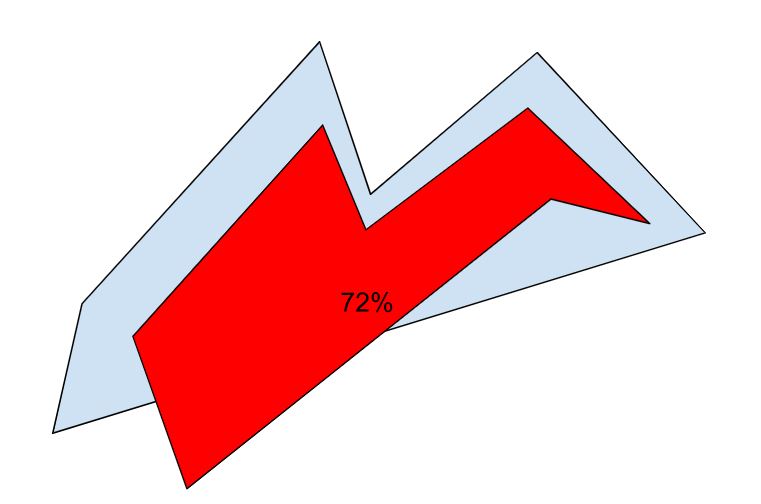
Rubric vs. internal score, overlaid — the delta is the gap between the two outlines.
So teachers adjust. Sometimes the rubric gets bent toward the internal scale until it feels natural — until the score the rubric produces matches the score the teacher was already thinking of, within an acceptable delta.
There will always be liberties, because over-standardising anything kills it. Even nature knows this: it builds "error" into DNA transcription on purpose. Mutations.
None of this means the rubric isn't necessary — it is, the same way any measuring method is necessary. It's the weights, the tape, applied to knowledge output. The relationship between rubric and teacher is just never fully settled. The teacher will always wonder whether they pulled it equally hard each time.
Who adapts to whom
For internally designed rubrics — the ones a teacher builds themselves — the teacher shapes the rubric to fit their judgement. They calibrate it until the score it produces matches their internal reading, with acceptable delta. The rubric feels natural once it stops fighting the judgement and starts confirming it.
For standardised assessments like IELTS or the SATs, the direction reverses. The teacher adjusts their eye to fit the rubric, recalibrating their internal scale until it produces scores the rubric would recognise.
Both are valid. The difference is who's doing the adapting.
There will always be liberties. Over-standardising anything kills it — even nature knows this, and builds error into DNA transcription deliberately. Mutations aren't failures of the system. They're how it stays alive.
Feedback is where the actual learning happens
A score tells the student they're at point C. If point C is their goal, fine. But most students aren't aiming for point C — they want the summit. They want the selfie at the top, or at least to be able to say they made it. Whether they actually do the climb is the business of the serious ones.
Feedback tells the student why they're at point C. Good feedback tells them how to get to point A. Some feedback, though, carries them — bags, rope, and all — like a sherpa to the peak. And at that point, whose summit is it really?
So what's good feedback?
Feedback for grades and official reports, and feedback for student learning, are not the same thing.
Feedback for grading covers every error logged, every weakness noted — the full paper trail that justifies the score. It's complete by design, because its job is defensibility, not development. It justifies a score, fits a policy standard, or holds the fence against complaints. It's aimed at making the program — and by extension the teacher — look competent. God forbid they skip a mistake and get accused of not knowing.
Feedback for learning is for the student. It needs to be dumbed down, action-ified, and calibrated to where the student actually is. A beginner needs feedback that covers their plethora of surface-level issues. A good student needs to fix specific issues buried deep down in their thought process.
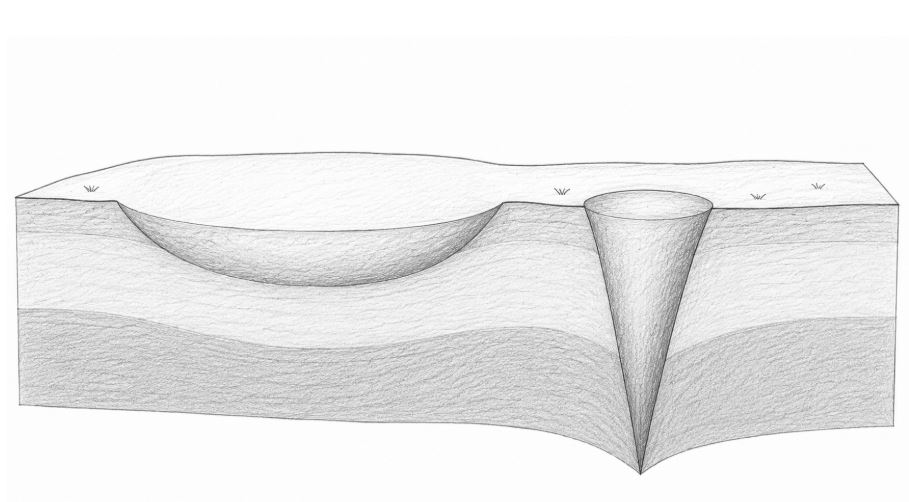
Broad feedback covers surface area. Deep feedback targets one point and goes all the way down. Different students need different shapes.
One rubric can't effectively speak to all these people in one go.
I fully believe teachers need one rubric for training — the same file, structurally, as the original rubric used for grading, but with correction, guidance, and inspiration pinned onto it as separate layers, not baked into the same rigid grid.
Diagram 3 — the same rubric, tagged row by row instead of collapsed into one grade: red for what's wrong, green for what's missing.